background  background

ARTICLE/Published Nov.2020
Revised Apr.2025–3 MIN READ

Role: Facilitator & workshop designer
Context: Industrial Design program, Konstfack


WORKSHOP
WITH INTENTION
In the fall of 2020, I co-held a series of lectures and workshops for industrial design students at ”Konstfack, together with my co-founder at Decent People. We explored topics like design methods, team development, communication, and ways of working together.

Konstfack later asked us to go deeper into workshop design itself - how to plan, shape, and lead sessions with intention, and how to find the right balance between structure and spontaneity.


visual
THE FUNDAMENTS
1
To explore the essence of workshops, we started with the basics: What is a workshop actually for? What does a facilitator really do?How do you design a framework with intention rather than habit?

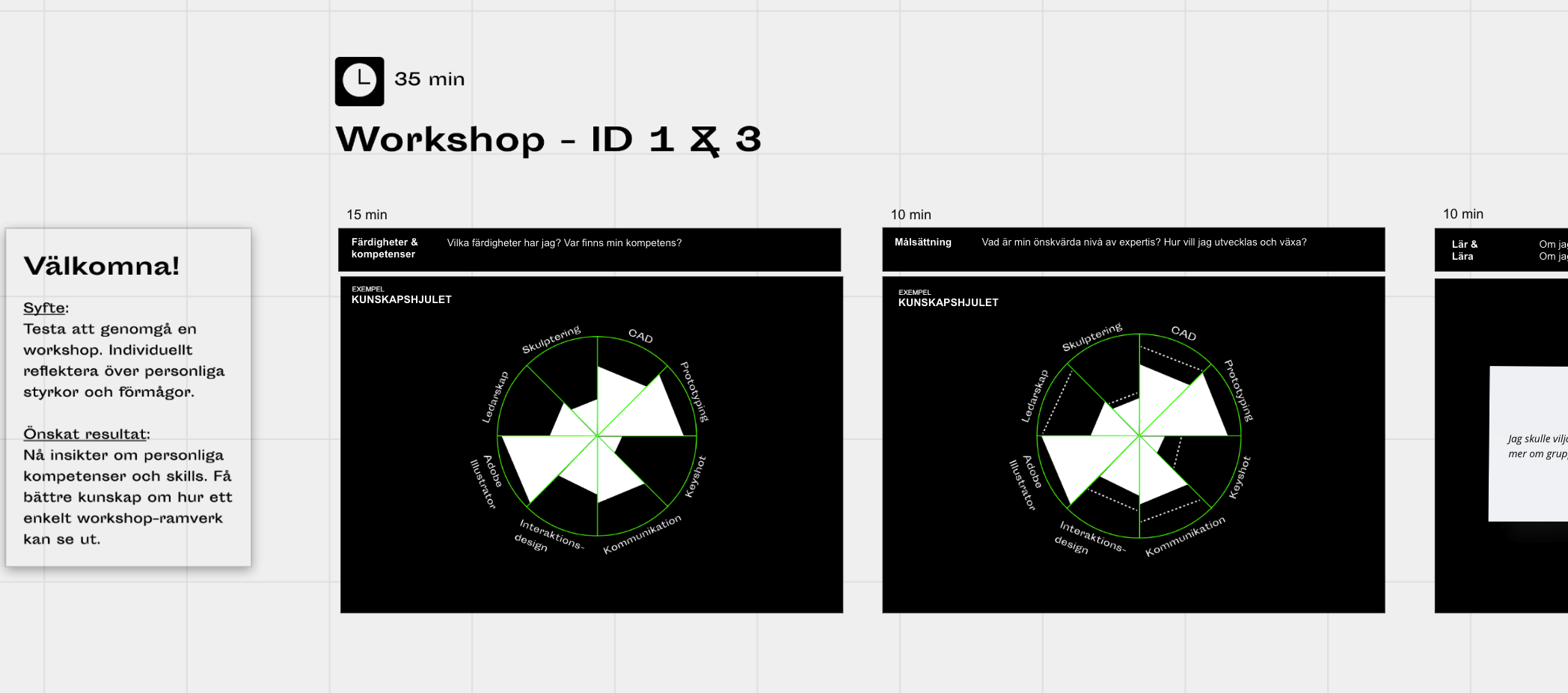
From there, we moved into practice. We facilitated a workshop for the students, breaking down the format:
 to give them direct, hands-on experience,
 to make the thinking behind workshop design visible, and
 to help them reflect on their own strengths and facilitation style.

It was a bit meta - running a workshop about workshops - but that was the beauty of it. Our aim was to make the process feel tangible and to lower the threshold for designing frameworks of their own. The session opened up thoughtful discussion and reflections. By the end of it, students had a clearer understanding of how to design and facilitate workshops themselves - not as rigid formats, but as intentional frameworks they could adapt to their own projects, teams, and personalities.

Stillness visual

Designing a Framework
2
From there, we moved into the practical work of designing a framework - how to shape a session from start to finish. Much like a good story, it needs a clear beginning, middle, and end. An opening that draws people in, a middle that carries the core content, and an ending that helps everything land.

The intention+desired outcome should guide the flow, influencing both how you prepare and how you show up in the moment. And it’s important to leave space for the unexpected—that’s often where the real insight emerges.

Once the structure was in place, the next step to go through with the students was how to lead a workshop - and that’s where facilitation comes in.

Stillness visual
Navigating facilitation
3
The definition of facilitation is [to make (an action or process) easy or easier] - at its core, it means making something easier - creating conditions for flow. In practice, this meant staying responsive to the energy in the room - knowing when to slow down, when to intervene, and when to step back and let the group carry the work forward.

Why do the work(shop)?
4
When designed with intention workshops become more:
— An energy boost that breaks habitual patterns
— A framework that nurtures co-creation
— Tangible seeds—ideas, sketches, conversations—that can take root and evolve
— A space for externalizing thoughts, building shared understanding, and aligning visions


At Konstfack, this approach helped shift workshops from habitual exercises into intentional spaces for shared clarity - where structure supported creativity rather than limiting it.”