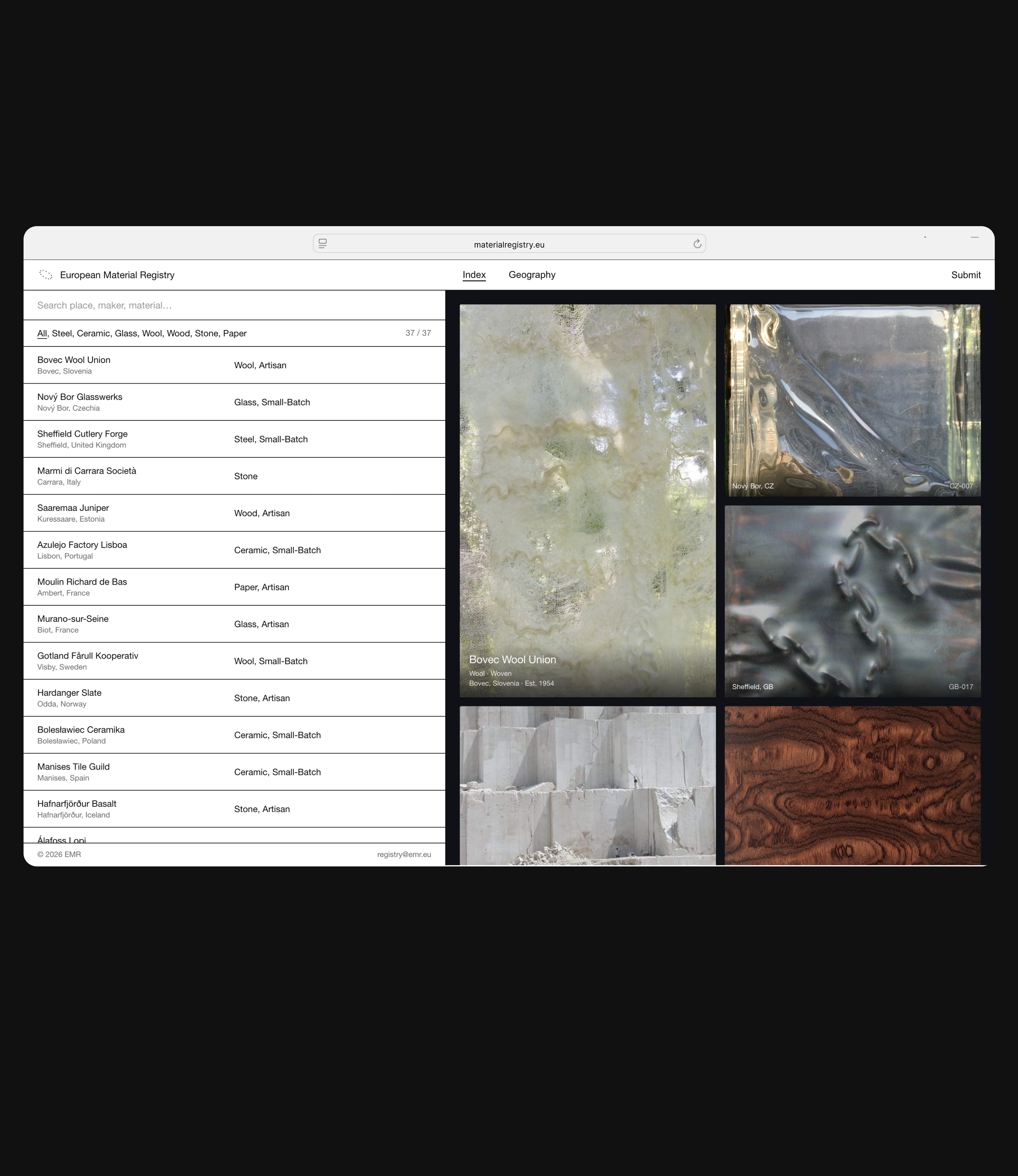
How do we make local production easier to find and connect within Europe?
European Material Registry (EMR) is a speculative digital registry exploring how local material knowledge, production and craft could become more visible, searchable and accessible.
Across Europe, knowledge about glass, wood, stone, textiles, paper, metal and ceramics is often deeply rooted in particular places. The information exists, but is scattered across local archives, company websites, associations and personal networks, making it difficult to discover.
What happens when local material and production knowledge becomes searchable?
THE FIRST PROTOTYPE
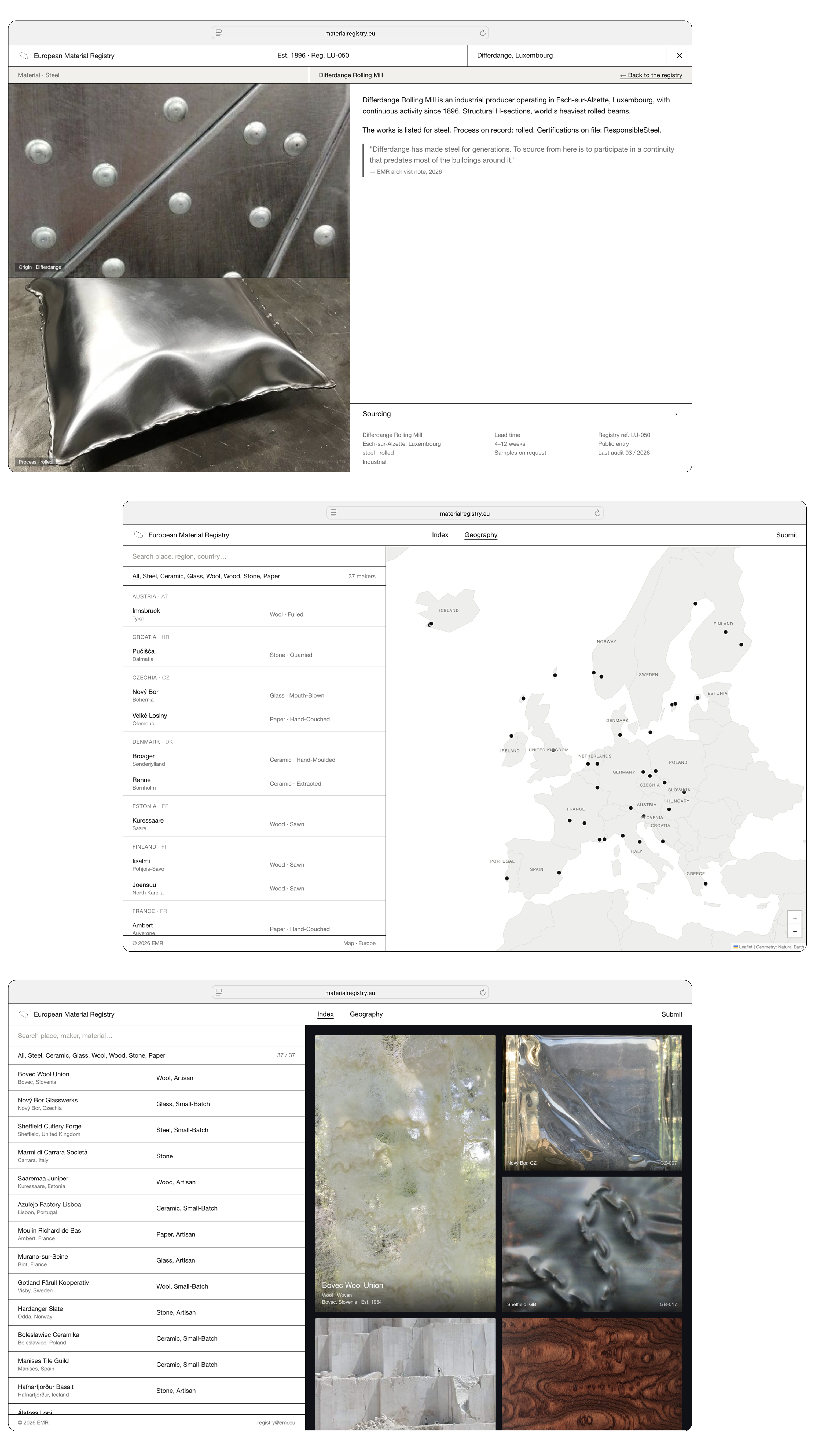
I developed EMR as an open registry of producers, workshops, makers and places where things are made. Entries can be explored by material, location and type of production.
Luleå. Limoges. Ardara. Nový Bor.
The idea is that production is defined not only by what is made, but by where the knowledge and infrastructure to make it exist.
The prototype is not intended as a finished service, but as a way to explore what a digital infrastructure for local production could look like—and what happens when scattered knowledge is organised into one system.
WHAT THE PROJECT ARGUES
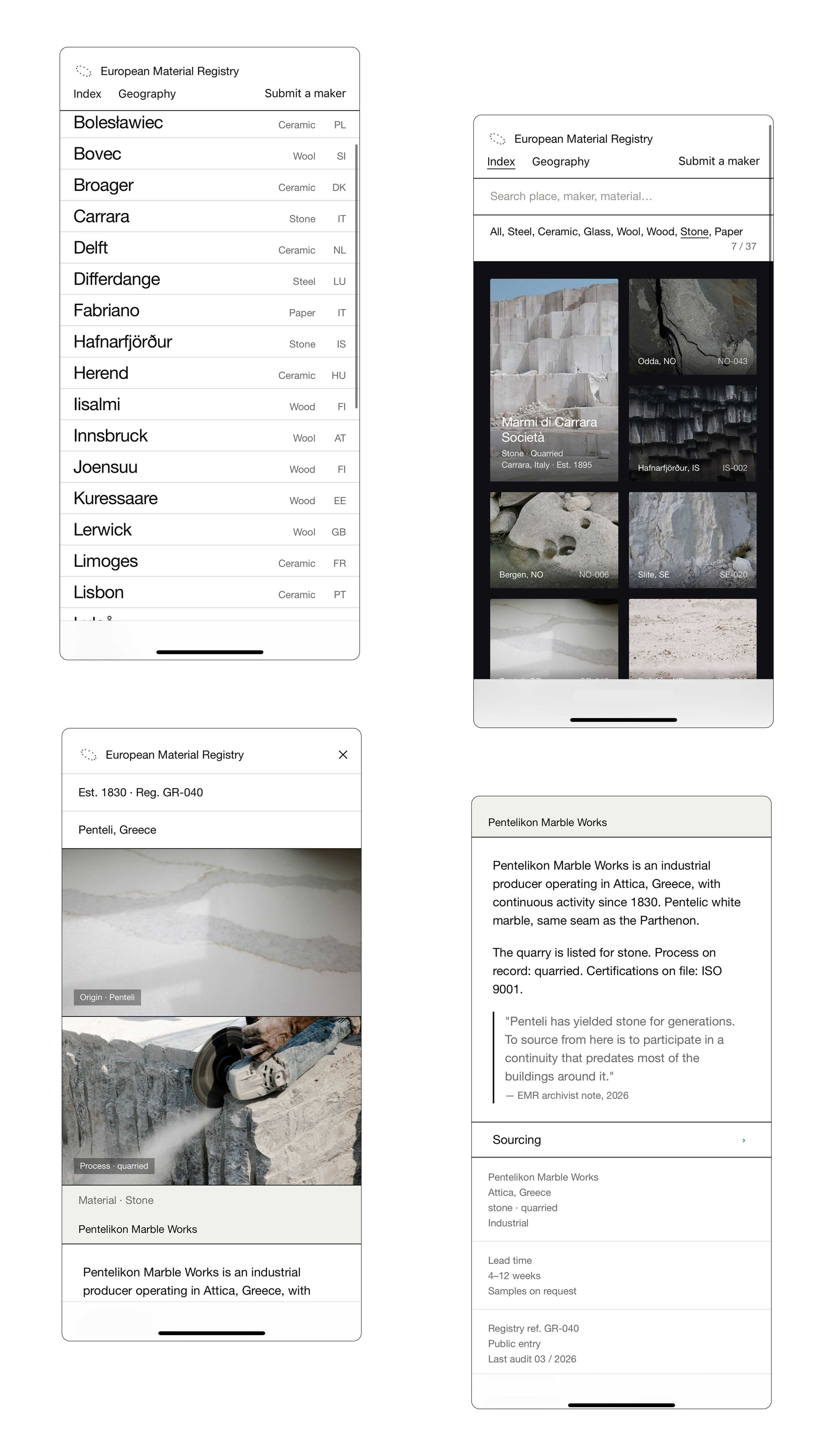
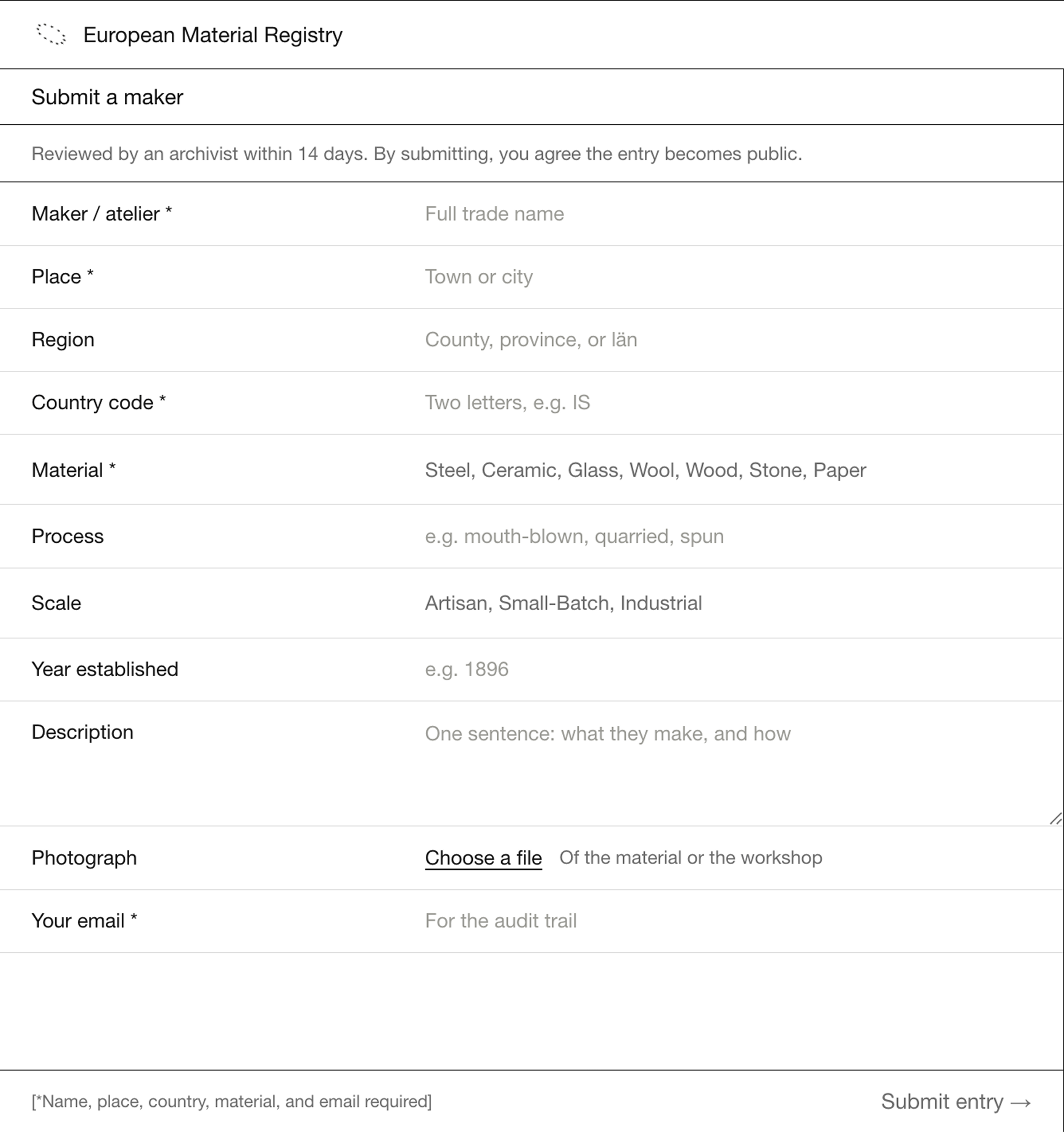
- Place as a starting point. Every entry leads with a town to show where production knowledge and infrastructure exist.
- Different scales belong in the same system. Artisan, small-batch and industrial production can be discovered side by side.
- Visibility should not be bought. No paid placement or promoted entries.
- Open does not mean uncurated. Anyone can contribute a maker or producer, but submissions are reviewed before entering the registry.
FROM POSTER TO REGISTRY
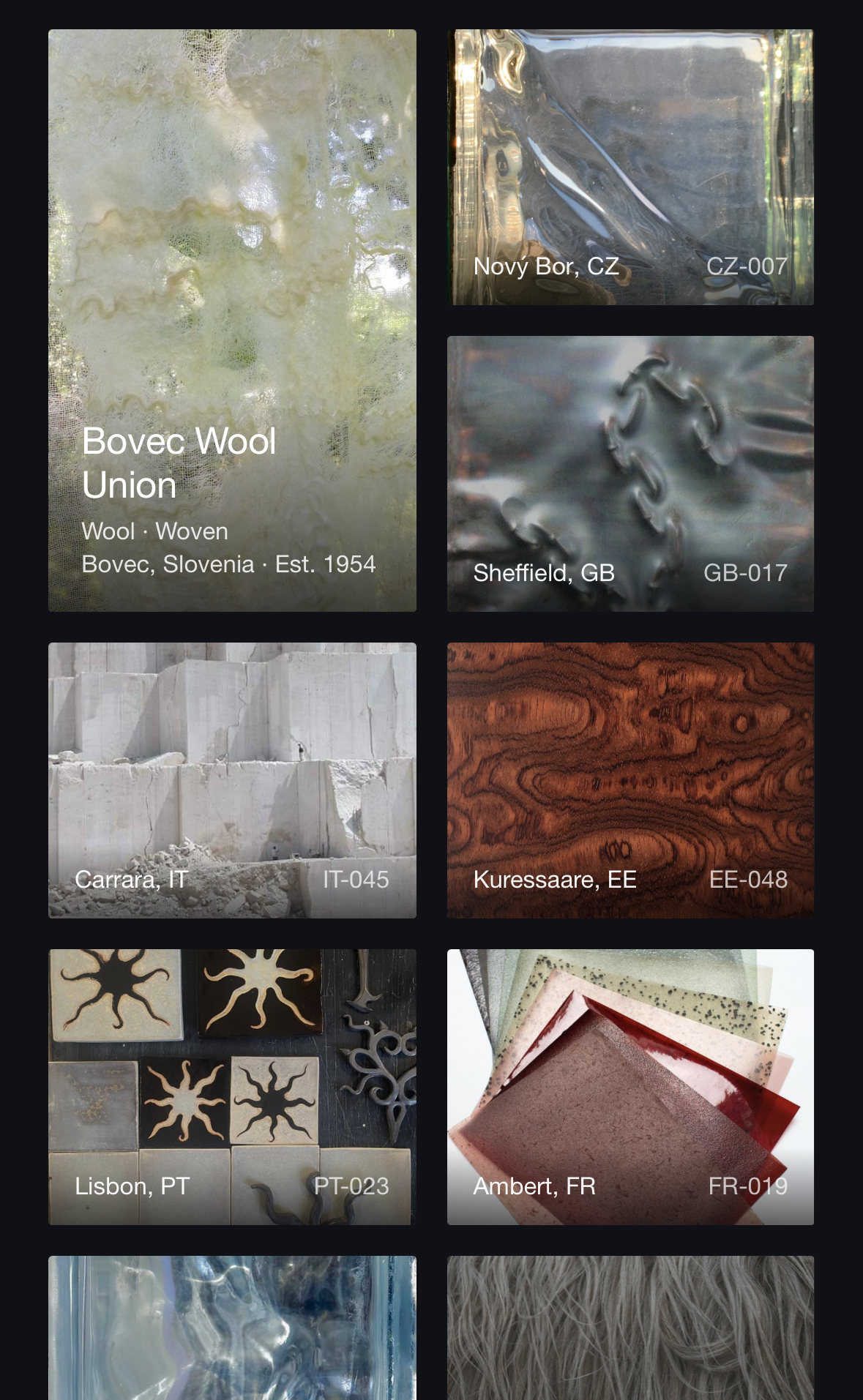
I initially approached the project through a more graphic language: halftones, color-coded rows, type as decoration. It looked good as a single screen, but failed as a tool.
With over 30 entries on a screen, the visual language competed with the information. People were unsure whether they were looking at a functional registry or something more decorative. That shifted the direction of the look and feel of the prototype.
I started looking at systems people already understand: Wikipedia, catalogues, directories and other information-heavy interfaces. The challenge became less about creating a distinctive visual language and more about making the registry immediately legible as a tool.
WHAT I'D DO NEXT
- Further user research to understand where this kind of registry could provide real value
- Replace the invented makers with verified entries
- Add lead times and minimum orders — two key factors in whether a small studio can work with a producer
- Introduce original photography with attributions
The next phase would involve speaking with producers, craftspeople and designers, while mapping the existing sources and networks through which this information is currently shared.
I would also develop the information model further: What should an entry contain? How should material, place, process, producer and history relate to one another? How much structure is useful before a local practice starts becoming oversimplified?
The broader question is how digital design can make existing knowledge more visible and discoverable without stripping away the local context that gives it meaning.